

Data Collection
Each year, the NWG Data Team receives food purchasing data from three dining entities across Grounds: UVA Dine, UVA Health System, and UVA Darden. This amounts to over 30,000 lines of individual purchased items annually. Each line includes information such as vendor name, product description, and weight.
Energy and wastewater data are provided separately by Facilities Management and the Office for Sustainability, covering Scope 1, 2, and 3 emissions.
Weight Calculation
As nitrogen footprint calculations depend on the weight of food purchased, not just quantity, a key step in our process is standardizing weight across all items. The Data Team uses a Python program, originally developed by former NWG student employee Emily Huber, to streamline this step.
The program handles two types of entries:
- Case 1 — Weight units (e.g. lbs, kg): Weight is calculated directly using the given weight, quantity, and a conversion factor.
- Case 2 — Non-weight units (e.g. count, bunch): The program uses fuzzy string matching to find a verified weight from the NWG's master reference sheet. If a match meets our similarity threshold, the master weight is applied automatically. If no confident match is found, the item is flagged for manual review by an NWG data team member.
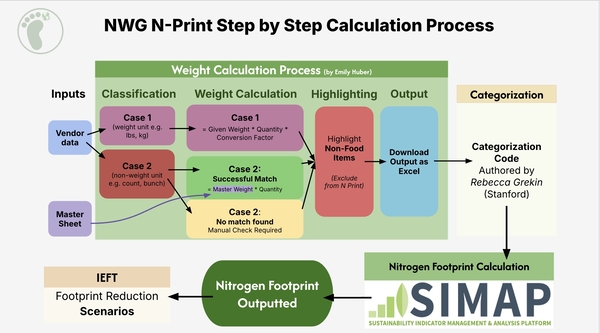
As the NWG moves more towards this automated approach, our efficiency has significantly improved; one year's worth of data is processed in one semester, down from four.
Categorization
Once weights are calculated, all food items are sorted into one of 18 food categories (such as beef, chicken, grains, vegetables, and dairy) using a categorization code developed by Rebecca Grekin at Stanford. Non-food items are flagged and excluded from the nitrogen footprint calculation. The categorized data is then exported for SIMAP input.
SIMAP Input and Footprint Calculation
The processed and categorized food data, combined with energy and emissions data, is entered into SIMAP (Sustainability Indicator Management and Analysis Platform) to generate UVA's nitrogen footprint. SIMAP applies nitrogen conversion factors across all 18 food categories and energy inputs to produce a total footprint figure measured in metric tons of nitrogen.
Validation
Before results are finalized, the Data Team validates the output by comparing it against prior years and accounting for any known changes, such as dining hall renovations, new facilities, or closures. This step ensures year-to-year changes in the footprint highlight patterns in consumption across Grounds.