Our Impact
Since its launch in Fall 2024, the Cognitive Science-Based Learning Hub has combined evidence-based instruction with systematic research to understand how first-year students develop effective learning strategies.
Through two consecutive cohorts, our evaluations have provided encouraging evidence that students can strengthen their metacognitive skills, adopt more effective study practices, and develop greater confidence in their academic abilities.
The Learning Hub at a Glance
- 2024: Year the Learning Hub launched at UVA.
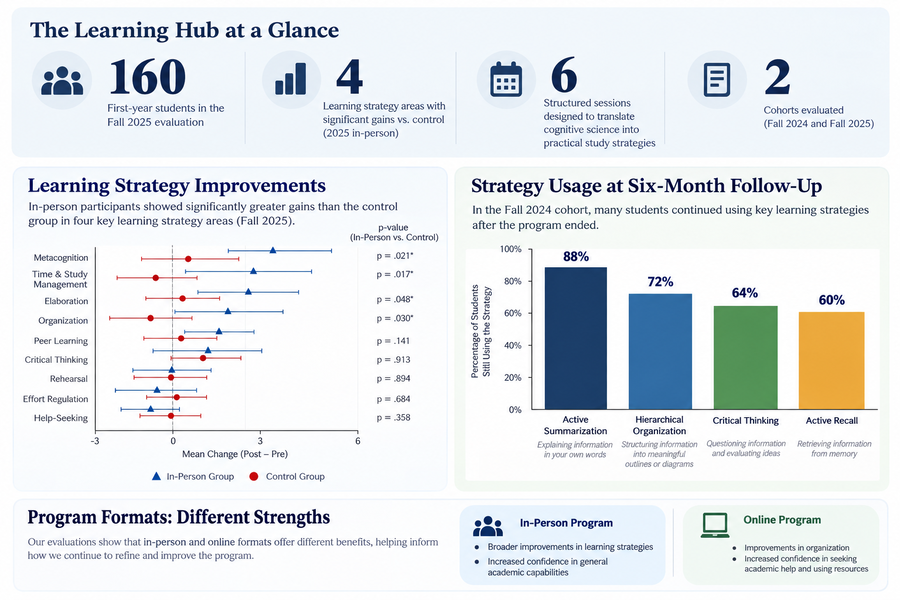
- 160 students: Included in the Fall 2025 evaluation across in-person, online, and control groups.
- 6 sessions: Structured learning experiences designed to translate cognitive science into practical study strategies.
- 2 cohorts evaluated: Fall 2024 and Fall 2025, informing ongoing improvements to the program.
What Have We Learned?
1. Students Develop More Effective Learning Strategies
Our evaluations indicate that participation in the Learning Hub is associated with improvements in several evidence-based learning practices.
Fall 2024: Results from Our Initial Pilot
Compared with students in the control group, participants demonstrated significantly greater improvements in:
- Critical thinking: Questioning information, evaluating ideas, and generating independent explanations.
- Active summarization: Explaining information in their own words and communicating concepts to others.
- Hierarchical organization: Identifying main ideas and organizing information into meaningful structures.
These findings provided initial evidence that explicit instruction and guided practice can help students adopt more productive approaches to studying.
Fall 2025: Evidence from a Larger Evaluation
Building on the pilot, our Fall 2025 evaluation included 160 first-year students assigned to in-person instruction, online instruction, or a control group.
Compared with the control group, students in the in-person Learning Hub program demonstrated significantly greater improvements in four learning strategy areas:
- Metacognitive Self-Regulation: Planning, monitoring, and adjusting their learning approaches.
- Time and Study Management: Organizing study time and creating productive learning routines.
- Elaboration: Connecting new information to prior knowledge and integrating ideas.
- Hierarchical Organization: Structuring knowledge through connections, associations, and levels.
These findings reinforce the value of explicitly teaching students how to learn, rather than assuming effective study strategies will develop naturally.
2. Students Apply What They Learn
An important goal of the Learning Hub is helping students transfer learning strategies beyond our sessions and into their everyday coursework.
In Fall 2025, students reported using several techniques introduced in the program:
- 71% of in-person participants used temporal organization strategies, such as distributing study sessions over time.
- 68% used mental imagery techniques to support memory.
- 66% applied active reading strategies.
- 55% used hierarchical strategies.
3. Learning Strategies Can Have Lasting Value
Our Fall 2024 follow-up evaluation provided encouraging evidence that students continued using several strategies beyond the intervention semester.
Approximately six months after participating:
- 88% reported continuing to use elaboration techniques.
- 72% continued using hierarchical study strategies.
- 64% continued applying critical thinking strategies.
- 60% continued using active recall techniques.
These findings suggest that the benefits of learning-strategy instruction may extend beyond the initial program experience.
4. Different Learning Formats Offer Different Benefits
In Fall 2025, we evaluated both in-person and online versions of the Learning Hub.
The in-person program produced broader improvements across learning strategies and was also associated with increased confidence in students' general academic capabilities.
The online program demonstrated positive effects in specific areas, particularly students' confidence in seeking academic help and using available resources.
Following a user experience study, the online program is undergoing review and refinement during Fall 2026 and is currently unavailable.
Looking Ahead: Learning in the Age of AI
The Learning Hub is expanding its research to investigate how AI can either support or undermine the cognitive processes essential for learning.
Our emerging work examines how students interact with AI tools, which cognitive activities they perform independently or delegate to technology, and how these choices influence learning and metacognitive development.
Building on our evidence-based learning interventions, we aim to develop approaches that help students use AI to augment their thinking without replacing the cognitive effort necessary for meaningful learning.
Our long-term goal is to help students become not only more effective learners, but also more independent, reflective, and adaptable thinkers.
About our findings: Results are based on program evaluations conducted in Fall 2024 and Fall 2025 using pre- and post-intervention assessments and comparison groups. Outcomes primarily reflect students' self-reported learning strategies and academic beliefs. Findings are informing ongoing program development and research.