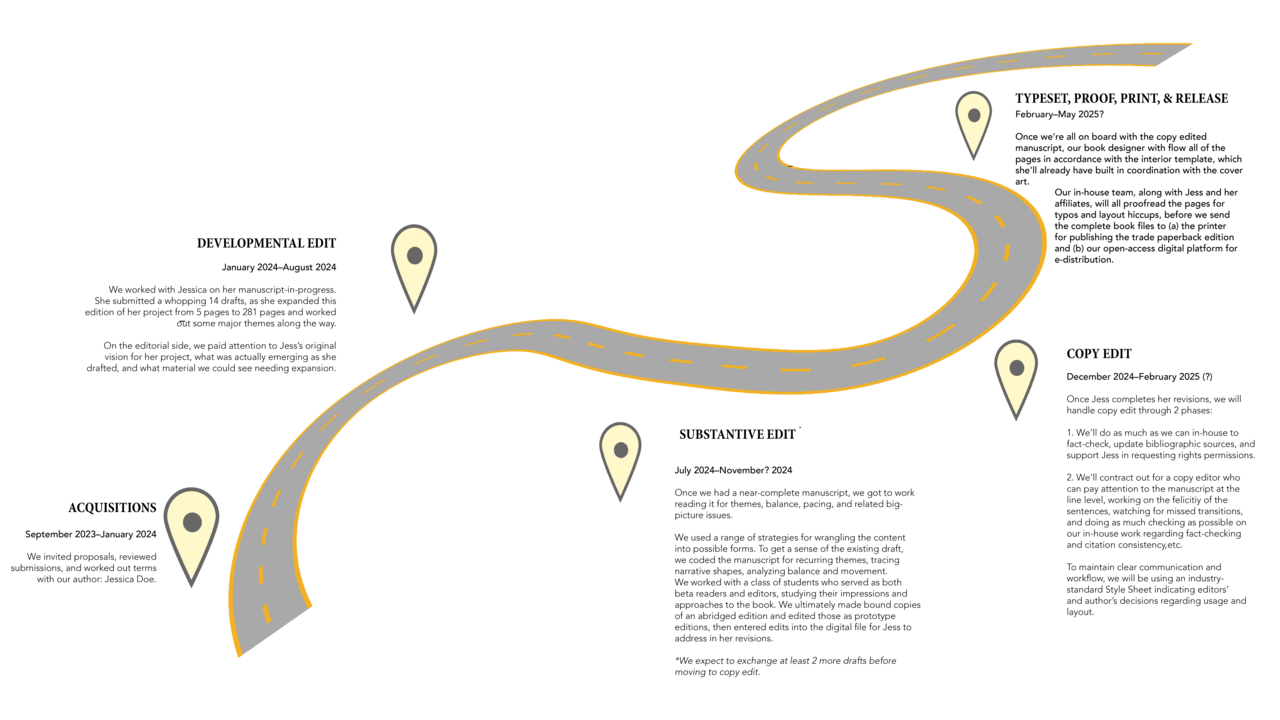
Our Process
Scroll down to read about our process and related files;
for more discussion, check out our blog and our podcast.
Acquisitions
View our original call for proposals here.
Here's Jess's original submission.
We chose Jess's book in part because it was exciting from a developmental perspective. Jess is an experienced author who's worked across genres--poetry, memoir, literary criticism. As you can see from the sample material, she'd also written on this topic for her dissertation, so we could see a lot of the ideas that would come through in the book. At the same time, the book would have to be substantially different from the dissertation. We scheduled an acquisitions call with Jess to talk through ideas, and we were excited by what she had to say about paths not taken during her PhD and possibilities for how those might go now, given more creative license.
Here's that first Zoom call--heads up, a lot of these calls were awkward, as they can be. :)
Developmental
We ended up spending about seven months on the dev edit, between January-August 2024. As much as you can measure the dev stage in drafts, I think it's fair to say we have about 13 drafts from that time. Most of these show the content growing, growing, growing, as we tried to figure out what Jess was going to do and where the book was going to go. For now, I'm just putting the files in by "Emails," "Drafts," "Zoom Calls," and "Less Filtered Reflections," with each category in chronological order. I may come back later and try to stagger the files into a timeline to better show each sort of "leap" in the book's growth.
From my perspective, the biggest challenge we faced on the editorial side for this stage was Jess's total separation from macro-structure. :-D She's a poet in her soul, and her attention to image, to the rhythms and distillations in language at a micro-level. But you may or may not have noticed that she didn't include any table of contents or précis with her initial submission--not that she had to, but *I* can't fathom writing without one myself. And when we asked her for these, she was definite: she does not work that way.
So we as an editorial team had to imagine, based on each subsequent draft, what the book could become. We sketched out possible tables of contents, possible narrative arcs; looked for emerging/recurring themes. And then we'd reverse engineer, asking Jess to send more content on X or Y when it seemed like we might need that material later in a sub-edit. We didn't want her revising anything at this point, just creating, but also we wanted to guide that creation so we'd have material that worked together and not just a whirlwind of disconnected content.
The biggest shifts that happened here included:
- moving from a dissertation that considered 5 different authors to focusing on Sylvia Plath
- adding significantly more memoir material from Jess
- adding more of a research-adventure narrative about Jess's time in the archives
- turning more toward Jess's poets and other authors
*Note: There are 20+ files you should be able to access here, mostly manuscript drafts and also files of emails and Zoom calls. We'll get them loaded shortly--technical challenges over here!
DevEdit
Substantive
During sub-edit, our team worked to wrangle all that content into an organized form that would retain the best of what Jess had created and provide a meaningful story shape to carry readers through the rich ideas and experiences embedded in the existing content. We also wanted to pare back some of the content that seemed to distract from the book's best work; the manuscript had gotten pretty out of control by the end of dev edits.
We worked individually and as a team. Grace, as you can see from our blog, set the tone by coding the whole thing for themes.
I also assigned a summer editing class of 6 students to read and reverse engineer the manuscript for recurring themes; Grace sat in that multi-hour class period to eavesdrop on their raw impressions and to help lead a group analysis exercise. Those same students then each took a print-out of the manuscript (the last dev-edited version) and spent time rearranging the pages, even cutting them up and changing passages around. They each wrote up a case for their visions for the book.
Finally, I assigned each of those students to select a shorter excerpt of the book that they either really liked or found meaningful. Miraculously, their sections did not overlap, so I took the resulting ~70 pages and edited THOSE into a short book with a Foreword, 4 chapters, and an Epilogue. I titled that project Poetic Dis/Order. That particular class was taught with the students completely offline, so after we hand edited on hard copy, I typeset and printed the pages, and then we folded and sewed signatures and bound them into casebound editions. I made 2 additional casebound editions for Grace and Maddie.
The 3 of us (Grace, Maddie, and I) read that very small edition and made additional sub-edits, highlighting what we found most compelling and what felt off-putting or out of place. Then I "edited in," going back to the long last dev edit version and added back material that was relevant to what had survived.
That process left me with a draft that was coherent, but still disorganized, without effective movement among "chapters." We hosted a beta reader group, where Grace and Maddie moderated a discussion with two additional volunteer readers. Those readers were reading the manuscript for the first time, and I worked from their impressions to continue wrangling the book into more distinct chapters, with a more structure apparatus and placeholders for transition material.
You can read more details about these moments on our blog.
At this point, generative AI had also taken on a significant role in my professional life--I had been providing faculty training across our institution on how to write and teaching writing effectively "in an age of AI." I decided to take the manuscript for a spin with ChatGPT. You can read the prompts I played with here. I found this side quest helpful, as the AI was able to recommend strong early chapter breaks I couldn't see because I was so caught in the weeds. I found its recommendations got worse after about 1/3 of the way through the manuscript, but by then I'd been able to recognize a workable pattern for chapter length, thematic balance within the chapters, and the types of chapter ending lines that were working best, so I had a much easier time finding chapter breaks throughout the rest of the file. Once those were in place, I could identify the need for language at major transition points. I also used ChatGPT to suggest chapter titles, some of which I retained before creating original titles.
*Note: You'll be able read the 6 major sub-edited drafts here; the student drafts are all in hard-copy in my office, though I will upload some representative photos shortly. There will also be emails and Zoom calls shortly.
Copy
Coming late Spring 2025
Production
Production actually happens across the lifespan of the editorial process. We start with a fact sheet, which we update every time something changes--the book's estimated page count, the title, the description, whatever. We start with very simple front cover copy, and initial cover design transmittal files, and initial cover comps. We talk to printers about material options like trim size and paper type and cover specifications, and we route covers until we're happy with the front cover, then move on the build-out. Here are our files:
Proof and Press-Ready Files
Coming Summer 2025