
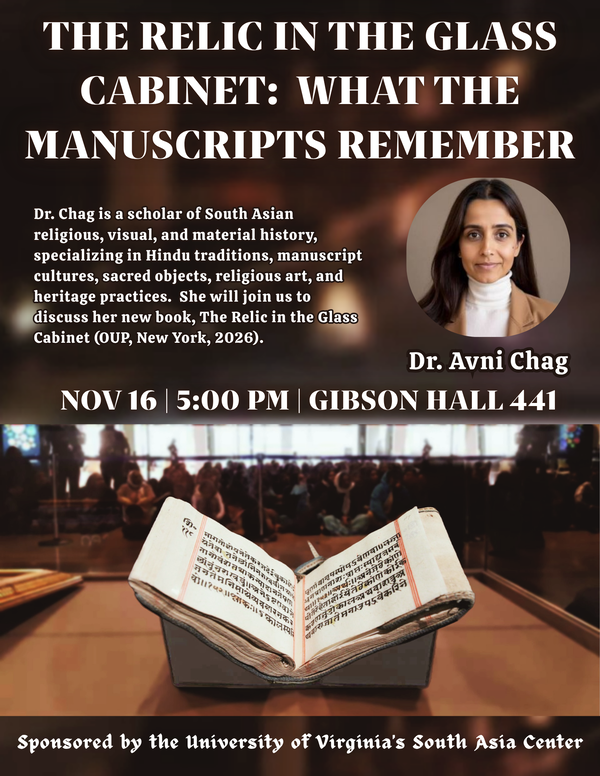
What happens when the historical evidence does not support the history everyone knows? The Śikṣāpatrī, a principal scripture of the Swaminarayan Hindu tradition, is said to have been composed by Swaminarayan in 1826. Yet no autograph survives, no known 212-verse copy dates from his lifetime, and the earliest dated text was produced after his death. More unexpectedly, manuscripts in India preserve an earlier 145-verse recension from 1823, without several of the doctrinal features now associated with the text, and the wider tradition. Tracking a specific manuscript that now sits behind glass in Oxford's Bodleian Libraries—treasured by librarians and venerated by devotees—this talk explores how a messy history of composition became a singular story of divine authority. Ultimately, we will ask: what happens when the evidence for a religious past becomes sacred itself?
Dr. Chag is a scholar of South Asian religious, visual, and material history, specializing in Hindu traditions, manuscript cultures, sacred objects, religious art, and heritage practices. Her research examines how texts, images, relics, artworks, and ritual spaces shape religious memory, authority, and historical consciousness across South Asia and its diasporas. She will join us to discuss her new book, The Relic in the Glass Cabinet (OUP, New York, 2026).