
Read below to learn about some of the work going on in our lab!
Red Oak Climate Adaptation (ROCA) Lab
- A part of the Adaptation to Climate and Environment (ACE) Transplant Garden Experiment, in collaboration with Jeannine Cavender-Bares (Directory Harvard University Herbaria) and Sydne Record (Associate Professor of Landscape Conservation UMaine)
- Motivation
- Forests are a vital stabilizing force for the climate, globally removing approximately 1/3rd of anthropogenic carbon emissions each year.But forest species are being decimated by invasive insects, climate instability, and landuse conversion. Managing our tree species requires both traditional forestry management (watering, thinning, etc) and genetic stock improvement (assisted migration and breeding disease resistance).
- Why Red Oak?
- The eastern region of the U.S. is over 60 percent forested and thus constitutes both a significant carbon reservoir and net sink. These forests have sustained decades of increasing ecosystem carbon uptake, reflecting reforestation following agricultural abandonment in the mid-late 1800s. However, eddy flux data and annual tree growth measurements from the past decade indicate that rates of carbon uptake and aboveground biomass accumulation in many eastern forests has been slowing down (eg. Harvard Forest) and in some cases even reversing trends to a net source (eg. Hubbard Brook). This trend is largely driven by changes to the dominant and highly productive canopy species red oak Quercus rubra.
- Despite the overall decrease in growth rates for red oak across the region, there is substantial within site variation, where some individuals appear to be resilient to change. Characterizing this resilience is key - why are certain individuals doing better than others? Can we utilize this information to better manage and revitalize oak-dominated forests? This work aims to understand the degree to which rapidly changing environemnts are altering forest trajectories and how genetic variation in resilience can be harnessed to bolster forest adaptation to climate.
- Experiment Overview
- The ACE experiment is designed to allow us to study the degree to which genetics versus environment dictate tree resilience (nature vs. nurture) in a critical landscape species - red oak (Quercus rubra). The study follows a traditional reciprocal transplant design - we take individuals from populations across the range of red oak (ie. those that are genetically adapted to different climates) and plant replicates of these individuals across multiple sites. In this way, we are making a full factorial experiment of climate and genetics (Figure 1).
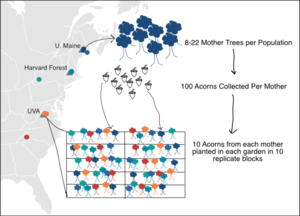
Figure 1: Illustration of the replicated garden design. There will be 3 gardens (Maine, Harvard Forest, and Morven), each with ≈900 trees. Each garden will have 10 replicate blocks, each block will contain 1 acron collected from each of the 8-22 mothers (Table 1) from each of the 6 populations (color coded by latitude in the figure above).
Promoting Climate-Resilient Agriculture Through Ecosystem Management in Virginia
- An interdisciplinary UVA Environmental Institute grant project testing shifts from conventional land use to regenerative agriculture, experimental forests, and grassland systems at Morven, while studying impacts on soil health, water quality, and biodiversity.
Within-Site Population Differentiation and Adaptive Significance of Nyssa sylvatica in Eastern North America
- Nyssa sylvatica, commonly known as blackgum, is a facultative, deciduous tree species present in a variety of ecological communities in eastern temperate forests. Facultative species have an equal probability of occurring in wetland and non-wetland environments; examples include sweetgum (Liquidambar styraciflua) and red maple (Acer rubrum). In forest environments, blackgum can be found anywhere from dry upland forests to saturated soils and riverbanks. Blackgum are commonly used as street trees and decorative plantings in urban and suburban settings due to their attractive fall foliage and tolerance to urban environmental conditions including road salts, heat, and pollution. Blackgum can be found in a remarkable variety of environments, but what enables this? Is this broad range of tolerances a product of plasticity, or has blackgum genetically adapted to these various microclimates?
- Trees can generate thousands of genetically diverse offspring each year; if one happens to fall in the right microsite (e.g. light, soil, moisture), it will germinate and potentially live on for hundreds to thousands of years. This research aims to understand the degree to which microenvironmental variation creates and maintains genetic differentiation in tree species within populations. Using blackgum as a proxy for other facultative tree species, this research investigates the adaptive capacity of N. sylvatica to respond to rapid environmental change.Furthermore, how does this genetic differentiation influence how we should be moving plants across landscapes? Perhaps blackgum growing in wet environments are genetically predisposed to have higher tolerances to environmental instability. If this is the case, should we prioritize moving those more resilient genotypes?
- In collaboration with: Paint Rock Forest, Blandy Experimental Farm, Mohonk Preserve, Vassar College, and Central Arkansas University
- Learn more at https://ethanskuches.com/nyssa-project/, or reach out to skuches@virginia.edu !
Broadening Our Understanding of Dormancy in Oaks
Background
- Many plants require a period of dormancy to complete development, whether annually in grasses or over long lifetimes in perennial hardwood trees like oaks. Much of our current understanding of this temporary cessation of growth is modeled on how plant compounds function in annual weed and crop species, such as Arabidopsis. However, because trees live for decades, these mechanisms must adapt to account for the cyclical periods of dormancy that deciduous trees experience during winter here in North America.
- Dormancy is onset by external environmental cues, such as decreasing temperatures and shorter photoperiod. Climate change is increasing global temperatures and drastically altering expected seasonal patterns. This leads to an increased frequency of phenological timing mismatches that can have detrimental effects on plant survival and reproduction; such as early budburst occurring in conjunction with late frost events.
Research Significance and Current Knowledge Gap
- Thus, it is important to identify these internal mechanisms that drive dormancy release in trees so that we can determine which compounds are involved, understand how climate change may affect this process in the future, and ultimately predict the impact on our future tree populations. Currently, various plant compounds are suspected to work internally by signaling a cascade of responses based on changes sensed externally in the environment. However, it remains unclear where this signal for dormancy release originates, and how it signals to the rest of the plant that the minimum chilling requirement of dormancy has been met, and that it is "safe" to resume development with appropriate temperature and photoperiod cues in the springtime.
Our Approach
- To answer these questions, we analyze plant compounds of interest in different tree tissues across time to track how these hormones fluctuate over the dormancy period, to understand the internal changes that are occurring before we can sense the plant has “woken up” exogenously in the spring. We collect tissue from various oak species across University of Virginia’s campus and have the tissue composition analyzed through assays and LC-MS to determine concentration, abundance, and function of important regulators throughout the year to try to capture this full period of dormancy in trees. Interested in helping with this project? Reach out to Emma (vkz2cq@virginia.edu).
Morven Farm Land Management
- Phenology Trail
- Invasive species monitoring & management
- Flora documentation