
Hooray! I (Tess) am back for blog post part two!
My time at Blandy Experimental Farm has sadly come to a close, but I wanted to give a quick debrief on my last few weeks!
Ethan and I have been side-questing around trying to find bear oak. On my last day, not only did we find bear oak, but we also stumbled into a forest of blackgum and striped maple, which was so gorg and super fun to explore.
In between our adventures, I was working on data analysis and writing my final paper. To recap, I simulated a drought on blackgum cultivars called ‘Wildfire.’ Ethan and I were interested in their drought tolerance because, as our climate changes, we can expect more arid conditions, including higher temperatures and longer stretches of drought.
What did we find, you might ask?!
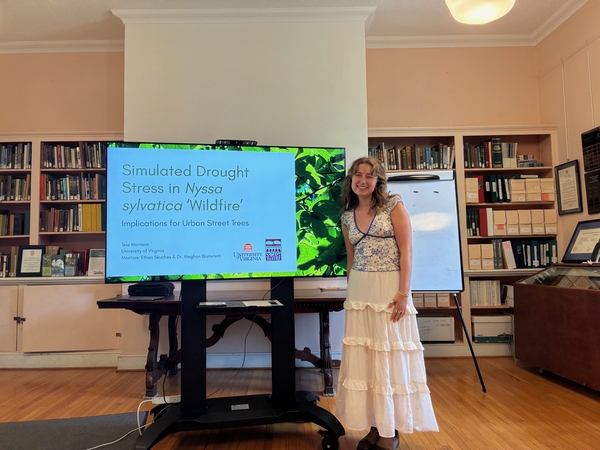
Well, last Wednesday I presented our findings at the Research Forum at Blandy (peep the photos!). The trees’ stomata closed, and transpiration dropped to near-zero rates within 5 days of drought. Within 9 days, the trees began to experience photosynthetic death, meaning all their leaves were dead! By the end of the experiment, 15 of our 17 droughted trees had experienced photosynthetic death.
Although we weren’t able to pinpoint an exact drought duration at which ‘Wildfire’ would fail, the experiment showed just how quickly these trees can decline under severe drought conditions. Now I’m interested in how our experimental drought compares to what ‘Wildfire’ trees may actually experience in cities. In the spring, I hope to continue data analysis, research drought projections for cities with populations of ‘Wildfire’, and compare these projections with the results from our droughted cultivars.
If you’re curious to see more of our results, I’d be so excited to talk in the spring when I’m back from studying abroad. Catch me at Enviroday!!