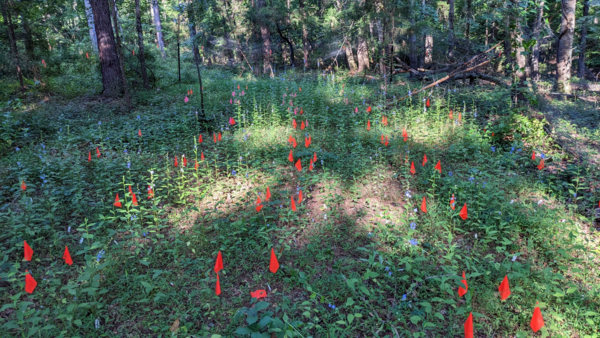
This study comes from my (Antoine) previous research project in the Galloway lab @ UVA. For almost five years, I the evolutionary consequences of long-term climate change in populations at the warmer end of the distribution of the North American plant Campanula americana.
Warm-edge populations often consist of relicts of populations that survived the last ice age and persisted more or less in place until today, known as the "rear edge". I got interested in these populations because of their long history of enduring climate change since last age, which makes them great models to study long term evolutionary response to future climate change. At the same time, these populations are often thought to be extremely vulnerable to ongoing and future climate change, because they already occur in the warmest conditions the species can survive, and may thus rapidly go extinct in the future. In this context, past evolutionary processes in these populations may have direct implications for their resilience or vulnerability to future warming.
To study the evolutionary legacies of past warming at the rear edge of C. americana, I combined population genomics, experimental crosses, and field experiments to test three distinct hypotheses: (i) rear edges may be hotspots of ancestral genetic diversity; (ii) past habitat decline and fragmentation may have exposed populations to strong genetic drift, reducing diversity and fitness; (iii) persistent selection under long-term warming may have resulted in strong local adaptation. I found that while these populations have lower diversity than other populations in the range, they show little evidence of having experienced high drift. Instead, I found that these populations have evolved strong local adaptation, and thrive in habitats that have become too warm for populations in the rest of the range, suggesting that rear edge populations have persisted under past warming through gradual adaptation.
This work was a great contribution to the field because it challenged the common view that rear edges are fragile populations with low fitness due to a history of drift, and shows that rear-edge popualtions can serve as model of adaptation to warming climates.
For more information and other papers related to this project, check out my website !