
Inspiring Future Scientists Above and Beyond
by Megan Moberg, UVA ChemSciComm
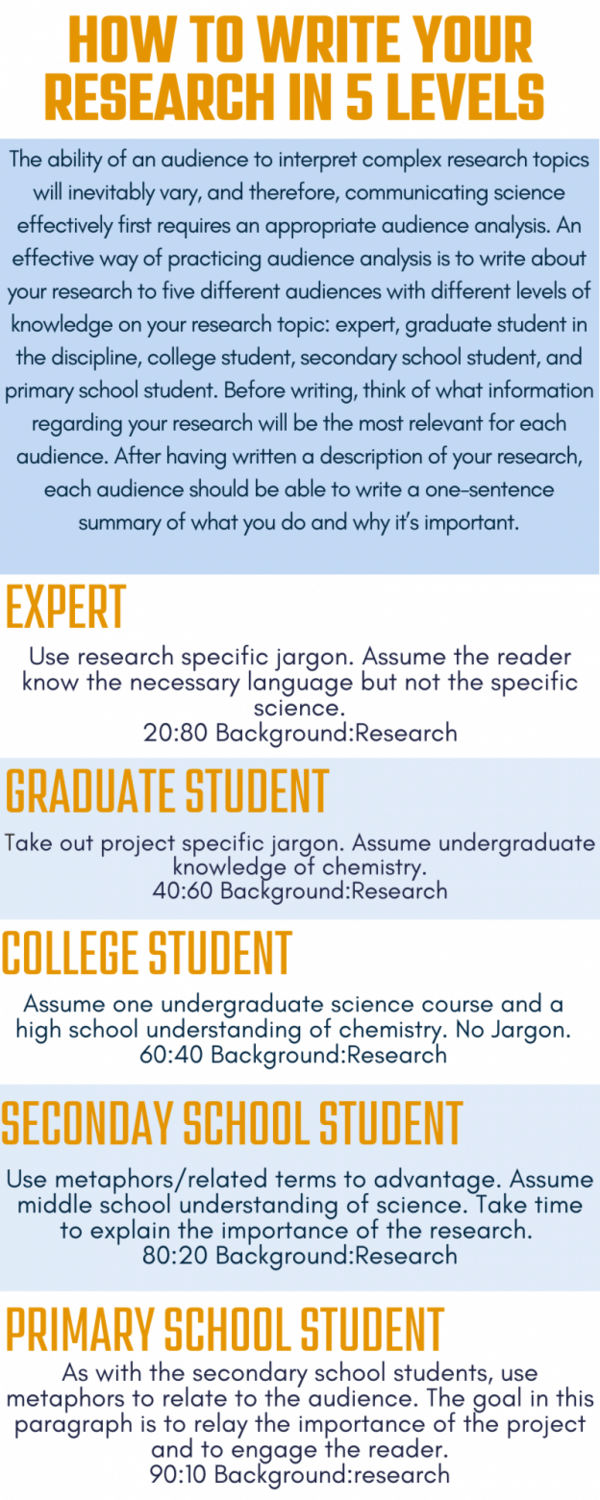
The ability of an audience to interpret complex research topics will inevitably vary, therefore, communicating science effectively first requires an appropriate audience analysis. An effective way of practicing audience analysis is to write about your research to five different audiences with different levels of knowledge on your research topic: expert, graduate student in the discipline, college student, secondary school student, and primary school student. Before writing, think of what information regarding your research will be the most relevant for each audience. For, experts and graduate students, you can be more technical with your narrative. For an expert, you want to communicate how your research is novel, fills a gap in your field, and even address problems with your work. For a graduate student, you want to describe the field of research you’re in and the novelty of your approach. College and high school students typically have less fundamental knowledge of your research problem, so you want to be more explanatory of certain concepts. These students will likely have some knowledge of general, organic, inorganic, and/or biochemistry, yet their understanding of how these concepts are practiced in research is limited. Secondary and primary school students have little to no fundamental background knowledge, so the goal may be to simply describe the “broad strokes” of your research and only focus on its significance. After having written a description of your research, each audience should be able to write a one-sentence summary of what you do and why it’s important.
Tips:
- Start from ‘expert’ and work to ‘primary school’
- Not every sentence needs to be rewritten as you move up or down in levels of understanding, evaluate whether the concept is essential to include at each level
- Think back to a time you were first learning the concepts of your research, then relay the information that was most beneficial in improving your understanding.
- Ratio of background/significance to chemistry and biology changes (high background/significance when low on educational ladder)
This entry was posted in 5 Levels of Understanding, Research Highlights on January 25, 2023 by Amelia Reid.
Expert: For this level, use research-specific language. Assume the reader knows most of the necessary verbiage, but not the specifics of the science – 20:80 Background:Research
Graduate Student in Discipline: Take out project-specific technical language. Assume mastery of undergraduate-level chemistry – 40:60 Background:Research
College Student: Assume one introductory undergraduate science (chemistry or biology) course and a high school understanding of chemistry. Do not use technical terms – 60:40 Background:Research
Secondary School Student: Use metaphors to explain key concepts. Assume middle school understanding of science. Take time to explain the importance of the research – 80:20 Background:Research
Primary School Student: As with the secondary school students, use metaphors to relate to audience. The goal in this paragraph is to relay the importance of the project and to engage the reader – 90:10 Background:Research
This entry was posted on January 25, 2023 by Amelia Reid.