
This page contains supplementary files for the article
Opening up baryon-number-violating operators
Julian Heeck, Diana Sokhashvili, Anil Thapa
arXiv:2603.17050
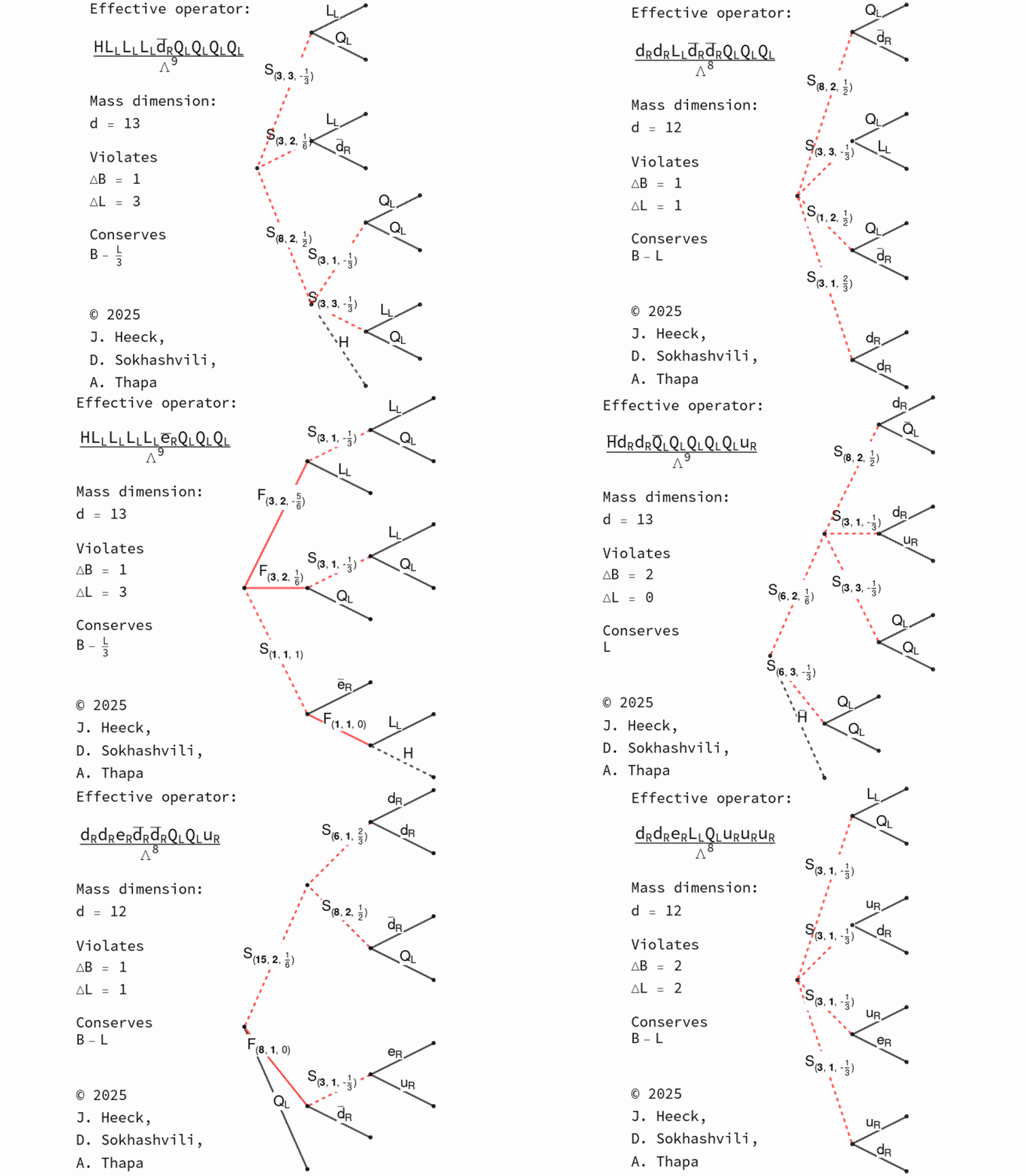
Generating topologies
Generate_topologies.zip (60 kB) contains a pedagogical Mathematica notebook and FeynArts model file to generate tree-level topologies.
We provide all topologies up to mass dimension 15 used in the paper as well as some topologies at lower mass dimension that are not relevant for baryon number violation but might be of interest for other studies. Topologies beyond those can be generated easily using the Generate_topologies Mathematica notebook or per request by the authors.
topology_files.zip (10 MB, 175 MB unzipped) contains topologies in Mathematica's wl format organized by mass dimension of the associated non-derivative operator and the number of external fermions and scalars. For example, dim7_4F_1S.wl contains the two tree-level topologies for 4 external fermions and 1 external scalar that correspond to a non-derivative operator of mass dimension 7:
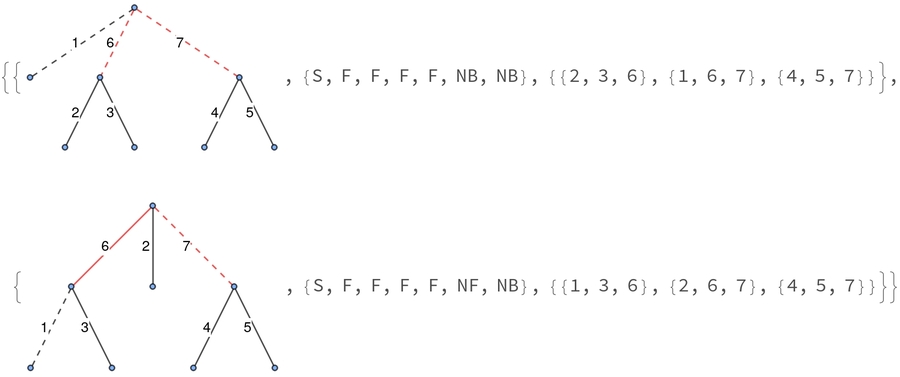
Each file is a list of entries that consist of a Mathematica Graph object with labeled edges, a list that collects information about the external and internal particles (S = external scalar/boson, F = external fermion, NB = internal boson, NF = internal fermion), and a list of vertices. E.g. in the first example, particles 2, 3, and 6 (as labeled in the graph) meet at one vertex, particles 1, 6, and 7 at another, and particles 4, 5, and 7 at the last vertex. Our topology format is redundant, the graph contains the same information as the last two entries together, so we also provide topology information in the form of text files, topology_text_files.zip (1 MB, 16 MB unzipped), which can be used without Mathematica and also contain a numbering of the topologies. The dimension-seven example from above takes the compact form
T[7][1] {"S", "F", "F", "F", "F", "NB", "NB"} {{2, 3, 6}, {1, 6, 7}, {4, 5, 7}}
T[7][2] {"S", "F", "F", "F", "F", "NF", "NB"} {{1, 3, 6}, {2, 6, 7}, {4, 5, 7}}
in this notation, where the first column defines the topology names (T[mass dimension][unique integer]) and the second and third column match the corresponding columns in the .wl files. Finally, we also provide pdf files of all topologies used in the article: topology_pdfs.zip (32 MB).
Generating UV completions
The above topologies can be used to UV-complete non-renormalizable effective-field-theory operators, in our case non-derivative baryon-number-violating νSMEFT operators up to mass dimension 15 (BNV_operators.zip, 40 kB, 300 kB unzipped) that were generated with Sym2Int.
Generate_UV_completions.zip (191 kB, 1 MB unzipped) contains a pedagogical Mathematica notebook to generate UV completions involving scalars, fermions, and vectors for non-derivative operators with tree-level topologies, including functions that check equivalency of UV completions, calculate the amplitude or operator expansion, check for Higgs asymmetry, and make pretty graphs. It relies heavily on GroupMath. It also contains functions that aid with the import of our BNV UV completions.
Data files of UV completions for baryon-number-violating operators up to dimension 15 can be downloaded here in Mathematica's .wl format as well as a more stripped down .dat format. Notice that the .wl folders increase drastically in size with mass dimension, e.g. UV_Dim12_1B_1L.zip takes up 186 MB but turns to 2.9 GB when unzipped.
For example, the zip file UV_Dim8_1B_1L.zip contains all UV completions for d=8 operators with B=1 and L=1, sorted by topology and operator. Inside, one can find UV_Dim8_1B_1L_T3_O1.wl, i.e. topology T3 and operator 1, which takes the form
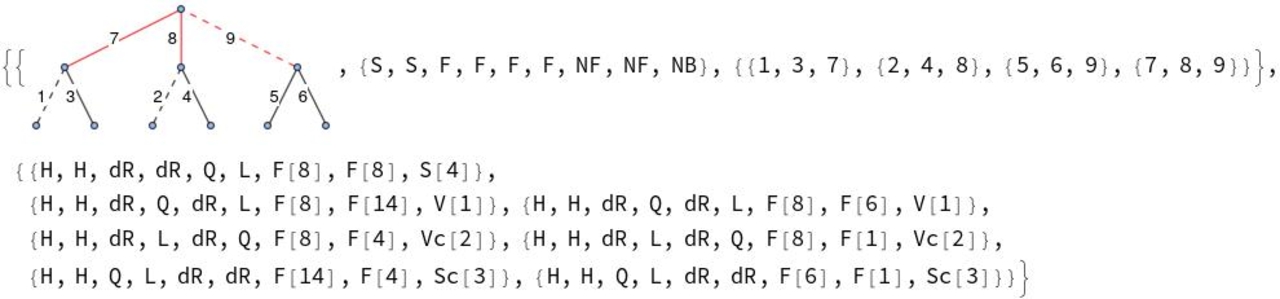
The first entry is the topology, the second a list of all possible inequivalent ways of distributing the external SM particles HHddQL around the diagram with consistent quantum numbers for the heavy internal fields. The particle names, F[8], Sc[3] etc correspond to the naming scheme in our article and can also be found in Generate_UV_completions.zip; importantly, the c stands for charge conjugation, i.e. Sc[3] is the antiparticle of S[3]. The same dimension-8 UV completions in .dat format only list which internal particles are in the diagram, e.g. in UV_Dim8_1B_1L_T3.dat we find
O_{8,(1,1)}^{1} F[8]F[8]S[4] F[8]F[14]V[1] F[6]F[8]V[1] F[4]F[8]V[2] F[1]F[8]V[2] F[4]F[14]S[3] F[1]F[6]S[3]
O_{8,(1,1)}^{2} F[8]F[14]V[1] F[6]F[8]V[1] F[3]F[8]S[4] F[14]F[14]S[1] F[6]F[6]S[1] F[3]F[14]V[2] F[3]F[6]V[2]
.....
More information can be found in the article and the provided notebooks. Please contact the authors with any questions or comments!