
DiCE: Digital Cultures and Economies
Today, the social internet is fully plumbed out with payments and other financial services. What were once niche practices have become part of popular economic culture: meme coins and meme stocks purchased through gamified investing apps, buy-now-pay-later platforms integrated into e-commerce sites, sports betting apps that reconfigure sports media, and payment systems enabling new forms of hustle economy.
As more and more livelihoods are being enfolded into the digital economy, more and more people rely on fintech platforms to receive payments, manage income, access credit, navigate algorithmic monetization systems, and sustain economic viability in precarious platformized markets. Fintech is not just a tool for financial transactions but a structuring force that shapes who can participate in the economy and under what conditions. The terms of this participation have changed underneath our feet, and many people of all ages feel unprepared to maneuver through it.
We are in the middle of a major reworking of our technological, social, and economic norms and expectations. We need to understand these changes, why they are happening, and how we should react to them.
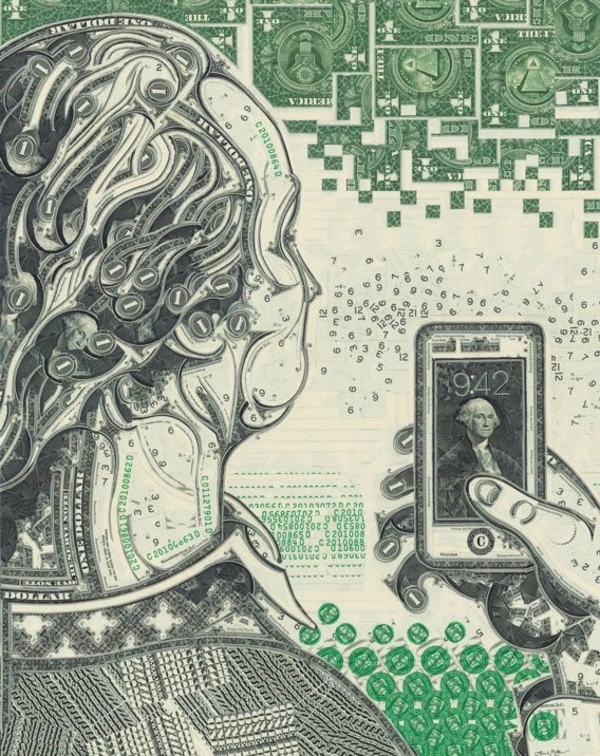
Mark Wagner, AMERICAN IDLE (DETAIL), currency on panel, 20x15”
Current Research
Network Scams Project
This project seeks to understand how scams are becoming increasingly central to understanding contemporary digital economic life. Moving beyond individual-level fraud prevention, this work aims to make visible how scams and anti-scam measures co-evolve with communication technologies, informing policy debates about platform governance, digital payments infrastructure, and the future of economic participation in an era where boundaries between legitimate opportunity and scam increasingly dissolve. Our first publication was Scam GPT: GenAI and the Automation of Fraud, a collaboration with Data + Society.
FLING: Financial Lives in a Networked Generation
Funded by Thriving Youth in the Digital Environment, this project examines how young people develop financial subjectivities and practices within today's complex digital economy—navigating finfluencers, crypto assets, buy-now-pay-later platforms, and more. Moving beyond traditional financial literacy measures, the research investigates emergent practices and competencies that might foster resilience and well-being, aiming to inform policy interventions and educational programs for an increasingly platformized and financialized economic landscape.
Cryptocurrency + Democracy
Funded by Digital Technology for Democracy, this project examines the relationship between democratic institutes and cryptocurrency technologies and industries. It tracks cryptocurrency-related policy and market developments. It is bringing together diverse stakeholders to foster meaningful dialogue. In addition, it creates accessible educational resources to help the public navigate this complex landscape. The overarching goal is to provide thoughtful analysis during a period of significant technological and political transformation.